
Dr. Maria Montessori, MD (1870-1952)
Italian pioneer woman physician, original creator of “The Montessori Method”
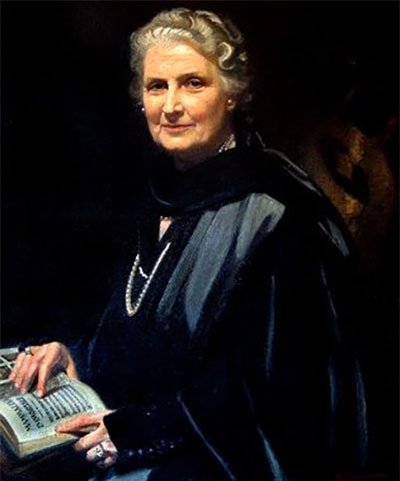
Maria Montessori was an Italian physician, educator, and innovator who developed the Montessori Method. Montessori was one of the first women in Italy to receive a medical degree, and she initially worked with children with special needs. Her observations led her to understand that children learn best in environments that encourage curiosity, self-directed learning, and respect for individual development. Her method, which remains influential worldwide, revolutionized early childhood education. In 1907, she opened the first Casa dei Bambini (Children’s House) in a poor district of Rome, where she implemented her educational principles. The success of this school attracted widespread attention and led to the global spread of the Montessori Method. Her approach is based on the belief that children are naturally eager to learn and capable of much more than traditional education systems tend to recognize.
Maria Montessori’s personal, societal, and professional challenges throughout her life not only shaped her theories but also fueled her passion for educational reform. Below are some of the key struggles and experiences that played a pivotal role in the development of her educational philosophy:
Key Struggles that influenced her method and educational philosophy
1. Gender-Based Obstacles in a Patriarchal Society
- Limited Opportunities for Women: As a woman in the late 19th and early 20th centuries, Montessori faced significant gender discrimination. In Italy, women were often excluded from higher education and professional fields, particularly in the sciences and medicine. Despite these societal constraints, Montessori was determined to pursue a career in medicine. She became one of the first women in Italy to earn a medical degree (in 1896), which was a remarkable achievement at the time.
- Breaking Barriers in a Male-Dominated Field: After becoming a doctor, Montessori faced resistance from male colleagues and medical professionals, who often underestimated or dismissed her. This struggle to gain professional acceptance in a male-dominated environment likely shaped her understanding of the importance of autonomy, respect, and independence—values central to her educational approach.
2. Work with Children with Disabilities
- Early Career in Psychiatry: Montessori’s early work involved treating children with intellectual disabilities. As a young doctor, she was appointed to work with children in a psychiatric clinic in Rome, where she observed the poor conditions and lack of stimulation for these children. Many of the children were treated as “uneducable,” and the prevailing belief was that children with intellectual disabilities were incapable of learning.
- Developing Tools for Learning: Montessori’s experience with children in this context was transformative. She began developing educational tools and materials designed to stimulate sensory exploration and learning. Her belief that all children, regardless of their intellectual capacity, could learn, evolved as she worked with these children. Montessori’s work with children who had disabilities laid the foundation for her later educational theories, as she realized that children learn best when they are allowed to engage with their environment and take an active role in their own education.
3. Social Reform and Advocacy for the Poor
- The Struggles of Poor Children in Italy: Montessori was deeply concerned with the plight of poor and disadvantaged children in Italy, particularly in the slums of Rome. In the early 1900s, Italian society was experiencing rapid industrialization and urbanization, leading to a growing divide between the wealthy and the poor. Many children from impoverished families were left to roam the streets, exposed to neglect, malnutrition, and crime.
- The “Casa dei Bambini”: In 1907, Montessori was given the opportunity to work with a group of poor children in the San Lorenzo district of Rome. This led to the creation of the first Casa dei Bambini (“Children’s House”), a Montessori school designed to provide a nurturing, stimulating environment for children from low-income families. Montessori’s experience with these children—who had been labeled as “uneducable” by society—was pivotal in the development of her belief that all children are capable of learning and deserving of a quality education.
4. Rejection of Traditional Educational Models
- Frustration with Conventional Education: As a trained physician, Montessori was acutely aware of the limitations of traditional educational systems, which were rigid, authoritarian, and focused primarily on rote memorization. She observed that conventional schooling did not support the natural development of children and was not designed to nurture independent, creative thinking. Montessori’s critique of the traditional school system reflected her growing conviction that education should be centered around the needs and developmental stages of the child, rather than the dictates of an adult-driven curriculum.
- Experiments with Alternative Approaches: Montessori’s frustration with traditional education led her to experiment with new ways of teaching. She sought to create a learning environment where children could follow their own interests, engage in hands-on activities, and learn at their own pace. Her goal was to create a system that fostered independence, self-discipline, and a love of learning, as opposed to one focused solely on obedience and conformity.
5. Development of the Montessori Method
- Development of Educational Materials: One of the most significant challenges Montessori faced was the creation of educational materials that could help children learn through sensory exploration and independent work. She designed materials like the “pink tower,” the “number rods,” and the “sandpaper letters,” which allowed children to experience abstract concepts in a concrete way. The creation of these materials was deeply informed by Montessori’s scientific background and her understanding of child development.
- Refining the Role of the Teacher: Another significant challenge Montessori faced was defining the role of the teacher within the Montessori classroom. She rejected the traditional role of the teacher as the sole authority figure and the center of knowledge. Instead, she envisioned the teacher as a “guide” or “facilitator,” someone who supports the child’s natural development without imposing rigid instructions. This shift in perspective was a radical departure from traditional teaching models, which emphasized top-down instruction.
6. The Opposition from Established Institutions
- Resistance from the Educational Establishment: Montessori’s methods were not universally accepted at first. Many educators, parents, and traditionalists were skeptical of her approach, which placed a strong emphasis on child autonomy and the use of unconventional teaching materials. Some criticized her methods as too permissive or lacking structure. Her educational philosophy challenged deeply entrenched notions about authority in the classroom, and many were resistant to her innovations.
- Conflict with the Catholic Church: Montessori also faced resistance from the Catholic Church, which was a powerful institution in Italy at the time. Her progressive ideas about education and her emphasis on child independence conflicted with the Church’s traditional views on obedience and authority. Despite this opposition, Montessori’s ideas spread internationally, and she eventually gained support from many progressive educators and thinkers around the world.
7. World War I and Political Challenges
- Disruption of Her Work: The outbreak of World War I was a significant personal and professional challenge for Montessori. During the war, many of her schools were shut down, and her work was interrupted. Despite this, Montessori continued to develop her ideas and to work toward the global spread of her educational philosophy.
- Political Challenges: In the years following the war, Montessori faced political challenges, particularly as fascism rose in Italy under Benito Mussolini. The fascist government was hostile to Montessori’s educational ideas, as they emphasized individual freedom and independence, which conflicted with the state’s authoritarian agenda. Montessori was forced to leave Italy in the 1930s and continue her work abroad.
Maria Montessori’s struggles were shaped by a combination of personal ambition, social reform, and scientific inquiry, and they played a crucial role in the development of her educational philosophy. Overcoming gender barriers, social and political opposition, and traditional educational models, she formulated an approach that emphasized respect for children, the importance of a prepared environment, and the value of hands-on, self-directed learning. Her personal experiences with disadvantaged children, her work with children with disabilities, and her observations of traditional schooling systems all contributed to her deep commitment to transforming education for all children.
Dr. Maria Montessori (The Montessori Method)
Intelligent, Research-backed Children’s Room Design
Montessori Toys
Leave a Reply